Muscle Memory, Not Catalogue Specs: What Timed Kit Trials Reveal About Load-Bearing Design

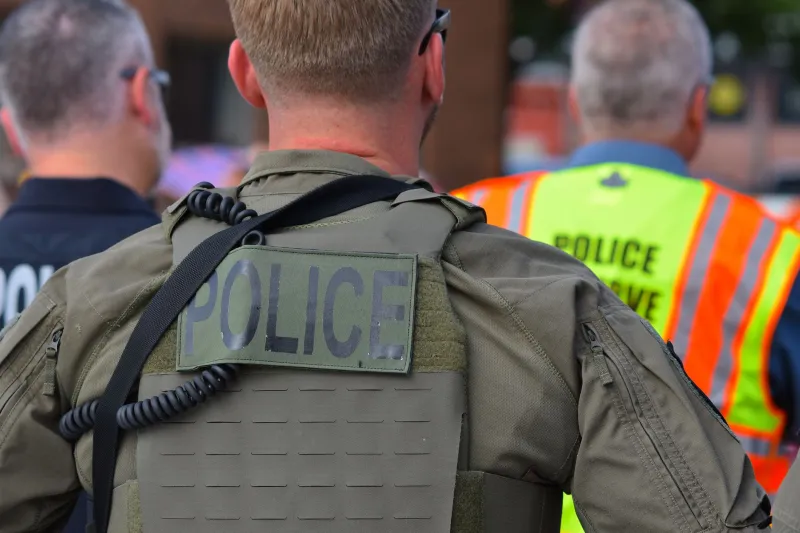
Photo: H Anderson from Valras-Plage & Sorède, France, CC BY 2.0, via Wikimedia Commons
Stand outside the training block at most force tactical training centres and you'll see something suppliers rarely witness: officers running the same draw, again and again, against the clock. Not for the assessment. For themselves. Because every officer learns early that the difference between a clean deployment and a fumbled one is measured not in product features, but in fractions of a second.
The Stopwatch Doesn't Read the Brochure
Catalogue specifications tell you what a piece of kit can do in the hands of a model photographed in ideal lighting. They rarely tell you what happens when an officer wearing a stab vest, a wet-weather shell and a loaded duty belt reaches for their baton with their non-dominant hand in the dark.
Informal time-and-motion work carried out with response officers across several forces suggests a rough pattern: a practised baton draw from a well-positioned holder takes around one to two seconds. A torch from a poorly placed pouch can take double that, particularly at night when the officer must first confirm which pouch is which. Trauma kit retrieval — often the most neglected item on the belt — has been observed taking upwards of eight seconds when the carrier sits behind the equipment of a colleague or is secured with a fastener that requires two hands.
Eight seconds is an eternity when someone is bleeding out. It's the gap between the approved design and the operational reality that this article is about.
Where the Seconds Go
Breaking down a fumbled deployment, the lost time tends to fall into four buckets:
- Locating. The officer doesn't know where the item is without looking. Any glance away from a subject costs situational awareness before the hand even moves.
- Accessing. Covers, flaps, bungee retainers and hook-and-loop closures all add friction. Some are justified — nobody wants a torch bouncing out during a foot chase — but many are specified for security reasons that don't survive contact with a real incident.
- Grip failure. Items recessed too deeply in a pouch, or gloves too thick for the draw, turn a simple pull into a wrestling match. This is where thin search gloves and deep torch carriers come into conflict.
- Cross-body conflict. A baton holder that sits where the radio microphone swings, or a first aid pouch that can only be reached with the wrong hand, creates interference that no spec sheet captures.
The 40-Second Benchmark
Some tactical trainers use a simple exercise: a full priority-action sequence — draw baton, deploy, stow, draw torch, illuminate, access first aid kit, apply a tourniquet to a training manikin — completed against a 40-second target. Officers familiar with their own rig routinely manage it. Officers on borrowed or newly issued equipment often don't.
The lesson isn't about fitness or training standards. It's that familiarity is a design outcome, not an accident. Equipment arranged consistently, with items in predictable positions and closures operable one-handed, becomes familiar faster. Equipment that varies between shifts, or between an officer's belt and their vest, never builds the unconscious fluency that pressure demands.
A Buyer's Checklist Built on Timings, Not Tick Boxes
For forces and authorised buyers reviewing load-bearing equipment, we'd suggest evaluating candidates against deployment performance rather than feature lists. A practical framework:
- Time every critical draw. Baton, torch, PAVA and trauma kit, gloved and ungloved, in daylight and darkness. Record averages, not best efforts.
- Test one-handed operation only. If a closure or draw requires two hands, ask what the officer is doing with the other hand during an incident.
- Check interference under movement. Run, crouch and grapple with the full rig. Anything that migrates, tangles or blocks another item should be flagged.
- Assess glove compatibility. Winter patrol gloves change the maths on every retention device on the belt.
- Evaluate consistency across the range. A manufacturer whose pouches position closures identically across the range reduces the learning burden when items are swapped or repositioned.
- Ask for the trial data. Suppliers confident in their ergonomics should be able to discuss how their designs performed in force trials, not just describe the materials.
Procurement's Quiet Responsibility
There's a temptation to treat deployment speed as a training matter — the officer should simply practise more. But the equipment buyer is the first link in that chain. A poorly positioned carrier or an over-engineered retention system sets a ceiling on performance no amount of drill can fully overcome.
The best kit, in the end, is the kit that disappears: the item that arrives in hand without thought, in the dark, in the rain, at the worst moment of someone's shift. Buyers who measure that — with a stopwatch and a willingness to watch real officers work — will make better decisions than those who read the spec sheet and sign the order.